
Table of Contents
- How to Measure Western Boots for Sizing: A Step-by-Step Guide
- Measuring Feet for Boots at Home: Getting Accurate Numbers
- Understanding Instep, Ball Width, and Shaft Circumference
- How Should Cowboy Boots Fit? The Snug Truth
- Cowboy Boot Heel Slippage: What's Normal and What's Not
- Brand Sizing Variance and Toe Shape: Why One Size Doesn't Fit All
- Foot Conditions and Printable Sizing Tools That Help
- Conclusion: Measure Once, Ride Comfortably
- Frequently Asked Questions
Last Updated: October 3, 2026
How to Measure Western Boots for Sizing: A Step-by-Step Guide
Learning how to measure western boots for sizing takes about ten minutes and saves you returns, blisters, and unworn boots.
The short version: trace both feet, measure length and width in centimeters, then match those numbers to the boot maker's own size chart.
Below, we cover the details most guides skip: instep fit, heel slippage, toe shape, and brand-to-brand variance.
What You'll Need Before You Start
Gather these first:
- A sheet of paper larger than your foot
- A pencil or pen held at a slight angle
- A fabric measuring tape
Measure at the end of the day, feet swell, and a boot that fits at 8 a.m. may feel tight by evening.
Step 1: Trace Your Foot on Paper
- Stand on the paper with your heel against a wall or straight edge.
- Shift your weight so you're standing normally, not leaning.
- Have someone trace the outline of your foot, holding the pencil upright.
- Repeat for the other foot on a second sheet.
Stand while tracing; sitting changes your foot's shape and throws off the length.
Step 2: Measure Foot Length and Width
- Draw a straight line from the tip of your longest toe to the back of your heel.
- Measure that line in centimeters.
- Mark the widest part of your foot, across the ball.
- Measure that width in centimeters.
- Repeat for your other foot.
Write down all four numbers. Size from your larger foot.
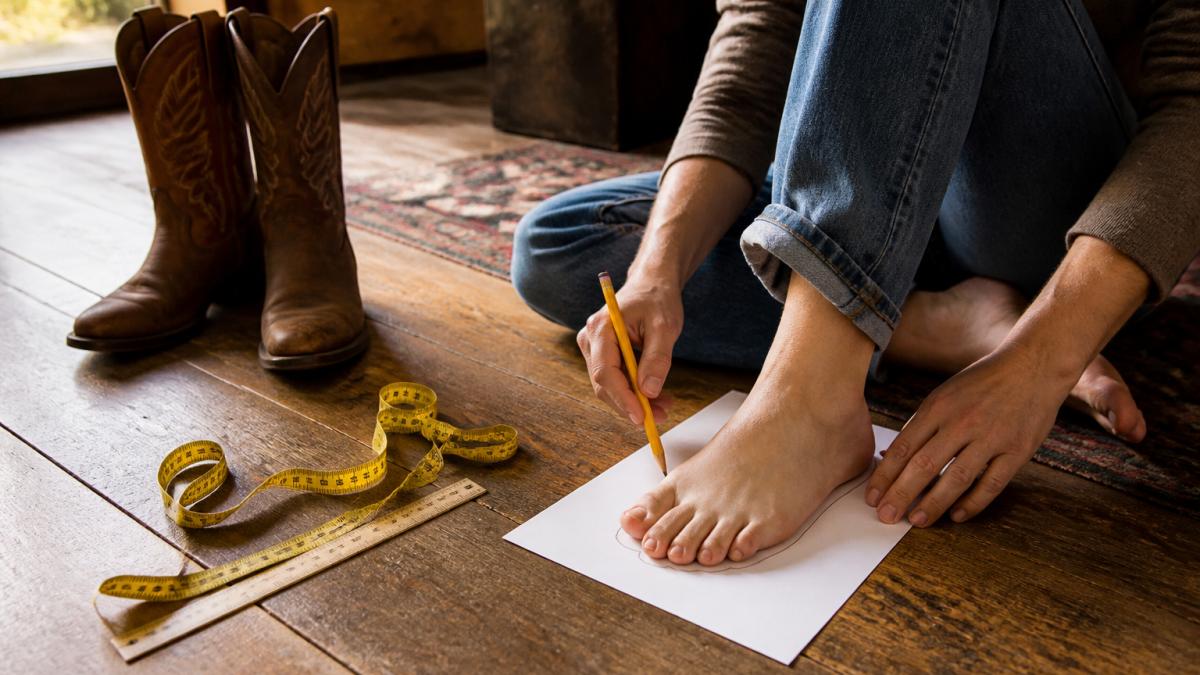
Measuring Feet for Boots at Home: Getting Accurate Numbers
Measuring feet for boots at home works well if you avoid a few common mistakes: tracing while seated, pulling the tape too tight, or measuring only one foot.
Keep these tips in mind:
- Wear the socks you'll ride or work in.
- Measure both feet, every time. Most people have one foot slightly larger.
- Convert carefully. One inch equals 2.54 centimeters (Approximate Conversions from U.S. Customary Measures to Metric | NIST).
A common mistake is rounding down because a size feels "close enough." Western boots do not stretch much in length, width is where leather gives.
Understanding Instep, Ball Width, and Shaft Circumference
Three measurements decide whether a boot feels right: ball width, instep, and shaft circumference.
Ball width: the measurement that sets your width letter
Ball width is the widest part of your foot, just behind the toes at the joint of the big toe and the pinky toe. It decides whether you wear a standard, wide, or narrow width.
How to measure it:
- Stand on the paper with your weight evenly distributed.
- Mark the widest point on the inside of your foot and the widest point on the outside.
- Measure straight across between those two marks in centimeters or inches.
- Repeat on the other foot and use the larger number.
Men's standard width (D) and women's standard width (B) fit feet measuring roughly 3.5 to 4 inches across the ball at a men's size 9.
Instep: the measurement almost nobody takes
Instep is the top of your foot, from the ball back toward the ankle. It is the most overlooked measurement in western boot fitting, and it decides whether a boot slides on easily or fights you every morning.

How to measure instep circumference:
- Sit with your foot flat on the floor.
- Wrap a fabric tape around the highest point of the top of your foot, running it under the arch and back over the top.
- Keep the tape snug but not tight. You should be able to slide one finger under it.
- Write down the number in inches.
A high instep makes pulling boots on harder and can create pressure across the vamp. A low instep leaves the boot loose over the top even when length and width are correct.
Shaft circumference: the calf fit
Shaft circumference is the opening at the top of the boot. It decides how the boot sits against your calf and whether it stays put when you walk.
How to measure it:
- Measure around the widest part of your calf, usually a few inches below the knee.
- Compare that number to the shaft measurement listed on the boot's size chart.
- If your calf is larger than the listed shaft, look for a boot with a wider opening, an adjustable style, or a pull-on with elastic goring.
Most men's western boots list a shaft opening around 13 to 15 inches, and women's boots often run 12 to 14 inches.
| Measurement | Where to Measure | Typical Range | Why It Matters |
|---|---|---|---|
| Foot length | Heel to longest toe | Varies by size | Sets your base size |
| Ball width | Across the widest part | ~3.5-4 in. at men's 9D | Decides width (narrow, standard, wide) |
| Instep | Around the top of the foot | Varies widely | Affects how the vamp sits and how easily the boot pulls on |
| Shaft circumference | Around the widest part of the calf | ~13-15 in. men's, ~12-14 in. women's | Decides how the boot sits at the top |
If your calf is larger than the listed shaft, look for a wider opening or an adjustable style.
How Should Cowboy Boots Fit? The Snug Truth
Cowboy boots should fit snug across the ball and instep, with a little room in the toe box and slight heel movement. That surprises people who expect a sneaker-like fit.
The fit breaks into three zones:
- Ball and instep: snug, almost firm. This is what holds your foot in place.
- Toe box: roomy. Your toes should wiggle freely.
- Heel: slight movement, roughly a slip, not a slide.
A new pair feels firmer than a broken-in pair. Leather stretches and softens with wear, especially across the vamp and instep, so a boot that feels slightly tight in the store often becomes your best-fitting pair.
Cowboy Boot Heel Slippage: What's Normal and What's Not
Cowboy boot heel slippage is normal in a new pair. Your heel should lift slightly as you walk, maybe a quarter inch, then settle back down.
A western boot is built on a stiff sole with a shank and a heel counter that hasn't molded to your foot yet.

What is not normal:
- Your heel lifts more than half an inch with every step
- The boot rubs and blisters the back of your heel
- Your foot slides forward and your toes jam the front
If any of those happen, the size or width is likely wrong.
Brand Sizing Variance and Toe Shape: Why One Size Doesn't Fit All
No two boot makers cut the same last, so a size 10 in one brand can fit like a 9.5 or a 10.5 in another. The last is the foot-shaped form a boot is built around, and it decides the length, width, and arch of the finished boot, the biggest reason to measure your foot rather than trust your usual size.
Why brand sizing varies
A last has a length, a width at the ball, a heel width, an arch height, and a toe taper. Change any one and the boot fits differently even at the same stamped size.
A few patterns show up again and again:
- Narrow lasts run about a half size small in length and feel tight across the ball. Boots built on these often need a half size up or a wider width.
- Wide, rounded lasts run true to size or slightly large and are more forgiving for high insteps and wide feet.
- Pointed and snip-toe lasts taper the front of the boot, which can make the boot feel a half size short even when the length is correct. The taper reduces toe room, not length.
This is why a size 10D in one maker's roper can feel like a 10.5D in another maker's dress boot.
How toe shape changes the fit
Toe shape is not just a style choice. It changes how much room your toes have and how the boot feels after an hour on your feet.
- Round toe: the most forgiving, closest to a standard shoe shape. Good for wide feet and high insteps.
- Square toe: more room across the front, popular for work and riding.
- Snip toe: a slightly tapered point. Dressier than a square toe but tighter across the toes.
If you have wide feet, bunions, or a high instep, a square or wide square toe will almost always fit better than a pointed or snip toe in the same size. If you have narrow feet, a pointed or snip toe can fit better than a round toe because there is less excess room.
How to size across brands
The practical approach: measure your foot once, then treat each brand's size chart as its own system.
- Measure your foot length and ball width in inches.
- Find the brand's size chart and locate the size that matches your measurements, not your usual shoe size.
- Read the brand's fit notes. Many makers state whether their boots run true to size, small, or large.
- If you are between sizes, size up in length and adjust width with the maker's width options.
- If you are ordering online, buy from a retailer with a clear return policy so you can try a half size up and down.
The outsole and welt also matter
The outsole and welt affect how a boot breaks in and holds its shape. A leather sole flexes and molds differently than rubber, and a Goodyear welt holds the boot's shape over years of use and allows resoling. None of that changes your size, but it changes how the boot feels after the first month.
Foot Conditions and Printable Sizing Tools That Help
If you have bunions, hammertoes, a high arch, or wide feet, standard charts may not tell the whole story. Look for brands offering multiple widths and detailed last descriptions.
Printable sizing tools help here. Many boot makers offer a printable foot measurement guide you can print at full scale and stand on.
For boots that need to go the distance, a few small tools make a difference. A Boot Hook at $12.99 lets you loop the ends through the pull straps and tug, which is easier on your back and your boot's straps. And a Tough-1 Western Boot Bag at $38.99 keeps a properly fitted pair protected with padded sides and an inner divider.

If you're near Dayton and want a hand, stop by and we'll measure your feet in person.
Conclusion: Measure Once, Ride Comfortably
The right fit comes down to a few numbers and a little patience. Trace both feet, measure length and width in centimeters, check your instep and calf, and match it all to the maker's own chart.
At Lazy B Western Wear & Tack, we stock western boots for men, women, and kids, along with the tack and gear that go with them.
Frequently Asked Questions
Is it better for cowboy boots to be too big or too small?
Neither is ideal, but too big causes more problems. Boots that are too large lead to excessive heel slippage, blisters, and poor arch support because your foot slides inside the boot. Too small creates pressure points on your toes and instep that won't improve with wear. The goal is a snug fit through the instep and ball of the foot, with about a quarter-inch of heel slip when new. Leather will stretch slightly over the break-in period, so starting snug is safer than starting loose.
Do you buy cowboy boots the same size as your shoes?
Not always. Brand-specific sizing variance means you should always check the manufacturer's size chart. Measuring your foot in centimeters or inches and comparing to the boot's listed measurements is more reliable than going by your everyday shoe size alone.
What is the slip test for cowboy boots?
The slip test checks heel movement when you walk. Put on the boots with the socks you'll wear, then take a few steps on a hard surface. A new pair should allow about a quarter-inch of heel slippage, which lets your heel seat properly as the sole breaks in. If your heel lifts more than half an inch or your toes jam forward, the size is wrong. Once the outsole and heel counter mold to your foot, that slip should nearly disappear.
How do I measure my foot width at home without a Brannock device?
Trace your foot on paper while standing, then measure the widest part across the ball of your foot with a ruler or measuring tape. Compare that number to the boot brand's width chart. Standard width is D for men and B for women, with wide and narrow options available. If you have a high instep or wide forefoot, size for the larger measurement and use the boot's shaft and lacing to manage the rest of the fit.